What Remains Between the Lines

Revisiting a conversation with Flowsofly about anonymity, reduction and why leaving something unsaid can be a form of precision.
The decision by Flowsofly to remain anonymous changes the way the work is encountered before the viewer has even considered a single line. In a culture where artists, writers and designers are increasingly encouraged to turn their identity into a parallel form of content, anonymity shifts the attention back to the work itself and removes many of the usual shortcuts through which audiences decide what they are looking at.
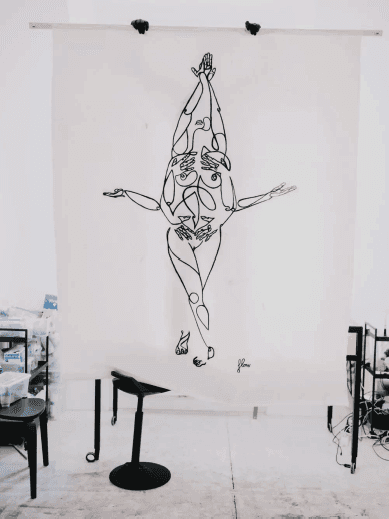
That was one of the reasons I wanted to speak with him for MAISON Ë. His drawings are highly reduced, but reduction should not be confused with ease. When very little remains on the page, each decision carries more weight because there is less visual information available to disguise uncertainty.
The discipline lies in knowing what can be removed without losing the emotional centre of the image. That is an artistic question, but it is also one that applies to communication more broadly. Brands, media and people often assume that clarity requires more explanation, while the opposite can be true. The more precisely an idea is understood, the less material may be needed to communicate it.
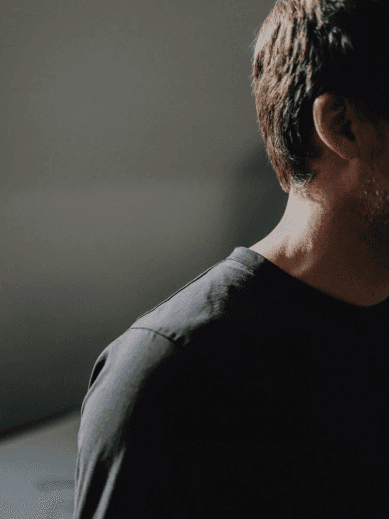
THE ARTIST WHO WISHES TO REMAIN ANONYMOUS.
“I’m always looking for a balance between specific and abstract, precise and open, explanatory and mysterious.”
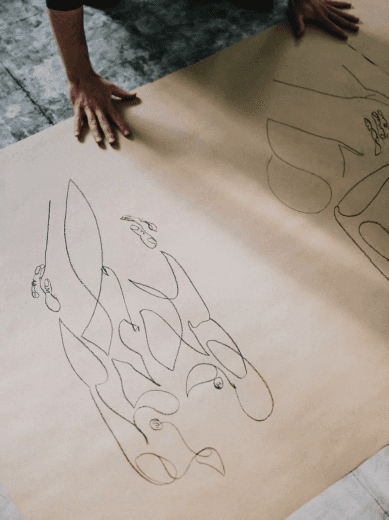
FEW LINES WITH GREAT EXPRESSION.
Flowsofly’s work also depends on the viewer completing part of the meaning. The lines are recognisable enough to suggest intimacy, vulnerability, relationships and sexuality, but they remain open enough for the audience to project its own experience into the image. That exchange between precision and incompleteness is part of what gives the drawings their emotional accessibility.
Our conversation inevitably moved towards social media because his work exists within a visual culture shaped by platforms. Those platforms have created opportunities for artists who may never have entered the traditional gallery system, but they also produce their own pressures. Speed, recognisability and repetition are rewarded, while work that requires more time from the viewer can struggle to compete with an endless stream of immediate images.
This makes curation more important rather than less. When access expands and publishing becomes frictionless, the scarce resource is no longer content itself. The scarce resource is judgement, both for the creator deciding what deserves to be shown and for the audience deciding what deserves attention.
That tension feels even more relevant now than it did when the original interview was published. We live in a period in which almost everyone can produce, distribute and promote visual material at extraordinary speed. The ability to add more is therefore becoming less distinctive, while the ability to recognise what should be removed, edited or left unsaid becomes much more valuable.
Flowsofly’s drawings are an unusually clear expression of that idea. Their intimacy does not come from exposure for its own sake. It comes from leaving enough space around an emotion for another person to enter it.
What I remember most from the conversation is that communication does not necessarily become stronger as it becomes louder or more complete. Sometimes the most direct connection is created when the work is precise enough to stop before it has explained everything.
credits
Interview and original words
Taskin “Tash” Yüksel
Artist
Flowsofly
Original publication
MAISON Ë, April 2025
Website note
This page does not reproduce the original Q&A and contains no unpublished interview material.
Photography
Stefan Fürtbauer

