What Luxury Deserves Our Attention?

Revisiting a conversation with Kerstin Groh on heritage, beauty, leadership and the limits of automation in luxury.
For a long time, luxury could rely on scarcity to do much of the work. Access was limited, distribution was controlled, and visibility itself carried a certain social value. That logic has become more complicated in a culture where almost everything can be seen immediately and where even the most exclusive object can appear hundreds of times on a screen before someone encounters it in person.
When I spoke with Kerstin Groh, Managing Director of Guerlain Austria, for MAISON Ë, I was less interested in producing a conventional beauty interview than in understanding how a heritage house thinks about relevance when attention has become one of the most competitive currencies in the market. Guerlain is a useful case because it operates with a long history, recognisable codes and a strong emotional vocabulary, while at the same time having to respond to changes in technology, consumer expectations and the way beauty itself is discussed.

KERSTIN GROH, MANAGING DIRECTOR OF GUERLAIN AUSTRIA
“In a world of constant overstimulation, modern luxury is no longer what generates attention, but what deserves it.”
KERSTIN GROH, MANAGING DIRECTOR, GUERLAIN AUSTRIA
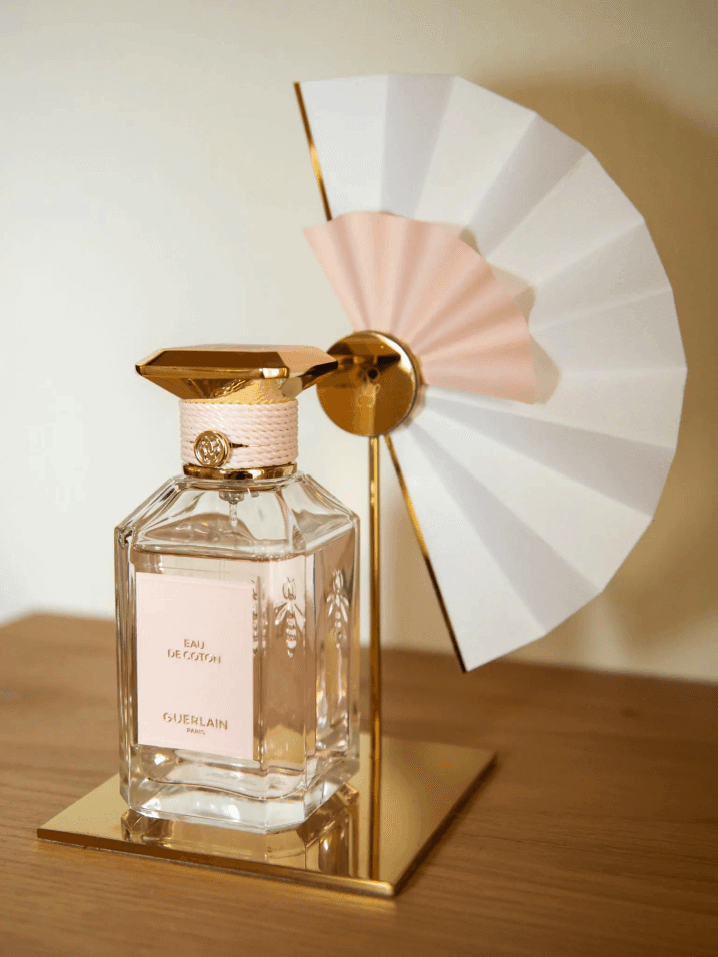
One of the most interesting shifts is the way luxury is gradually moving away from pure visibility. In an environment where everything competes to be noticed, the more valuable gesture can be restraint. This does not mean becoming quiet for the sake of appearing refined; it means understanding that relevance is no longer created simply by appearing everywhere. The brands that remain interesting tend to be those that know what deserves amplification and what should be left to the consumer to discover.
That question becomes particularly visible in beauty, where the language around ageing has changed substantially. The category spent decades speaking about correction, concealment and the preservation of youth, but consumers are increasingly drawn to ideas such as vitality, health, longevity and individuality. The aspiration has not disappeared, although the framing is changing. Looking untouched by time is gradually giving way to the more realistic and, in my view, more interesting ambition of looking well within it.
The same tension exists in leadership. Luxury brands sell products, but much of their value is built through emotion, context and trust, which means that technical competence alone is rarely sufficient. The ability to read people, understand cultural change and communicate with precision has become part of the infrastructure of contemporary management. This is particularly relevant in organisations whose products are expected to carry meaning far beyond their function.
“True luxury is an experience that touches the senses, nourishes the soul, and enriches life.”
KERSTIN GROH, MANAGING DIRECTOR, GUERLAIN AUSTRIA
Artificial intelligence makes that discussion even more urgent. The question is no longer whether luxury companies will use AI, because most already do in some form. The more revealing question is where they decide not to use it, and which parts of creativity, service and storytelling they still consider important enough to remain recognisably human. Technology can improve personalisation, research and efficiency, but it cannot automatically produce judgement, cultural sensitivity or a point of view. Those qualities are becoming more valuable precisely because so much else can now be generated quickly.
Looking back at the conversation, what interested me most was how often the themes extended beyond Guerlain itself. Heritage, beauty, leadership and artificial intelligence may appear to belong to different parts of the business, but they are all connected by the same question: how does a brand continue to evolve without losing the qualities that made people care about it in the first place?
That is the part of luxury I continue to find worth observing. The most enduring houses are not protected by history alone, and new technology does not make them relevant by default. Their advantage lies in the ability to interpret both with enough confidence to remain recognisable without becoming static.
credits
Words and perspective
Taskin “Tash” Yüksel
Original interview
Kerstin Groh, Managing Director, Guerlain Austria
Original publication
MAISON Ë, August 2026
Website note
This is a newly written retrospective based on the themes of the original interview; it does not reproduce the original Q&A.
Photography
Barbara Loschan

