What Restraint Can Make Visible

A visit to Hemmerle in Munich became a reflection on architecture, jewellery and the confidence required to let craftsmanship speak quietly.
When I visited Hemmerle in Munich, the first thing that stayed with me was not a piece of jewellery but the atmosphere around it. The new space was designed in a way that slowed down perception, using warm materials, curved forms and discreet rooms that allowed individual objects to appear without being forced into competition with one another.
That restraint became the real starting point of the story I later wrote for MAISON Ë because it reflected something fundamental about the way Hemmerle works. The environment did not try to create importance through scale or visual noise. It created attention by removing distraction, which is a much more difficult gesture in a luxury market that is often encouraged to make everything immediately legible and photographable.
The process behind the jewellery follows a similar logic. What interested me most was the way a stone can determine the direction of the object rather than simply being placed into a predetermined design. That reversal sounds subtle, but it changes the relationship between material and authorship. The design has to respond to what already exists rather than forcing a material into a preconceived form.

PERFECT HOSTS: YASMIN AND CHRISTIAN HEMMERLE
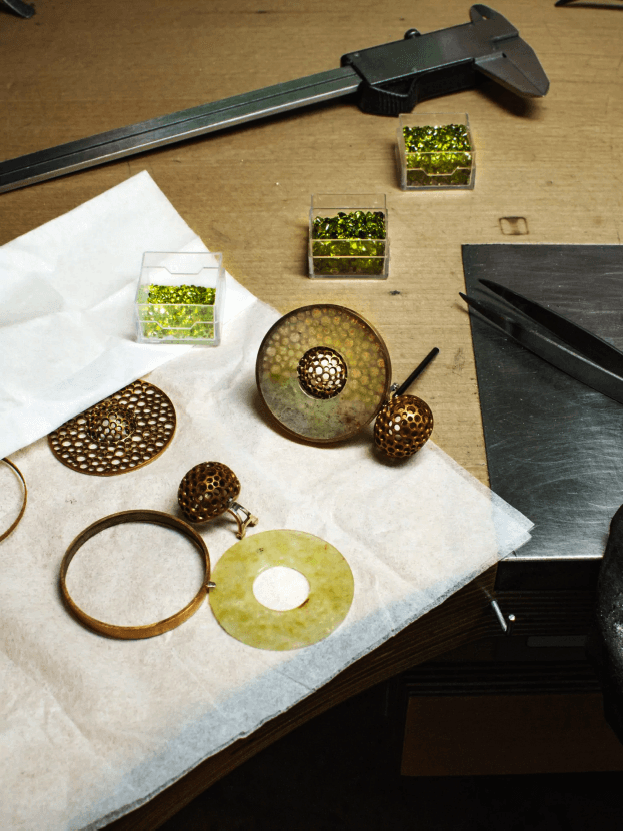
MASTERFUL CRAFTSMANSHIP FROM THE ATELIER: EARRINGS IN COPPER AND WHITE GOLD, SET WITH TOURMALINES.
Time becomes an important measure in that process. Luxury is frequently explained through rarity, price and provenance, yet in an atelier the more revealing measure is often the accumulation of decisions. The work is gradual and precise, and months of consideration can disappear into an object that feels completely resolved once it is finished.
This is why I find the language of effortlessness so interesting in craft. What looks inevitable at the end is usually the result of an enormous number of choices that could have gone differently. The achievement lies not in displaying the labour but in allowing the labour to disappear into the final object.
The Munich space made that philosophy visible without needing to state it. Architecture, material and jewellery were arranged with the same sense of proportion, and the room became part of the argument rather than a neutral background for the pieces. It suggested that value can be communicated through control rather than excess, and that luxury does not always become more convincing when every element asks for attention at once.
The broader question behind the original article was one I still return to: how does a heritage business remain contemporary without performing modernity? Hemmerle’s answer is not to chase novelty for its own sake. It is to continue working with an identifiable set of principles while allowing those principles to produce new forms.
That distinction matters because consistency and repetition are not the same thing. A house can remain recognisable without repeating itself, provided it understands which parts of its identity are structural and which are merely habits accumulated over time.
What I took away from the visit was therefore less a lesson about jewellery than a lesson about confidence. The most assured form of luxury does not need to explain every decision or amplify every gesture. It creates enough coherence that the viewer senses the standard before being told what it is.
credits
Words and perspective
Taskin “Tash” Yüksel
Original subjects
Yasmin and Christian Hemmerle
Original publication
MAISON Ë, April 2025
Website note
This is a newly written retrospective and does not reproduce the original MAISON Ë article.

