When a Heritage Brand Decides Not to Stand Still

At a BABOR press lunch, two new launches raised a larger question about innovation, credibility and what a 75-year-old beauty brand should add to an already crowded market.
There is a point at almost every beauty press presentation when I find myself wondering whether the market really needs another product, and I do not mean that dismissively. It is probably the most useful question a mature industry can ask itself because the beauty market has become exceptionally efficient at producing novelty, while novelty and innovation are not necessarily the same thing.
I recently joined BABOR for a press lunch where the company presented a new HSR Bi-Phase Face Oil and a Fine Fragrance collection consisting of three Eau de Parfums. The products were interesting, but the more compelling subject for me was the context in which they were being introduced. BABOR is celebrating 75 years, and a company with that amount of history faces a different challenge from a young brand whose identity is built around disruption.
Heritage can create trust, but it can also become a comfortable reason to repeat what has already worked. The more difficult task is to understand which elements of a brand should remain recognisable and where there is genuine permission to evolve. That question feels particularly relevant with Nicole Süss taking responsibility as General Manager for Germany, Austria and Switzerland, because leadership changes at established companies are rarely about making everything different. The better challenge is deciding what should remain untouched and what has become a habit rather than an essential part of the identity.
The new HSR Bi-Phase Face Oil is a useful example because it does not attempt to move BABOR away from its established skincare competence. Instead, it translates an existing anti-ageing line into a format that is more sensorial and more closely aligned with the way skincare language has changed. BABOR combines its HSR Lifting Complex with ectoin and a blend of botanical oils, positioning the formula around firmness, elasticity, hydration and barrier support.
I find the shift in language almost more interesting than the formula itself. Consumers have become less interested in the rhetoric of aggressive correction, while ideas such as resilience, barrier health, hydration and longevity have moved closer to the centre of the category. The desire for efficacy has not disappeared, but the way efficacy is described has softened and become more holistic.
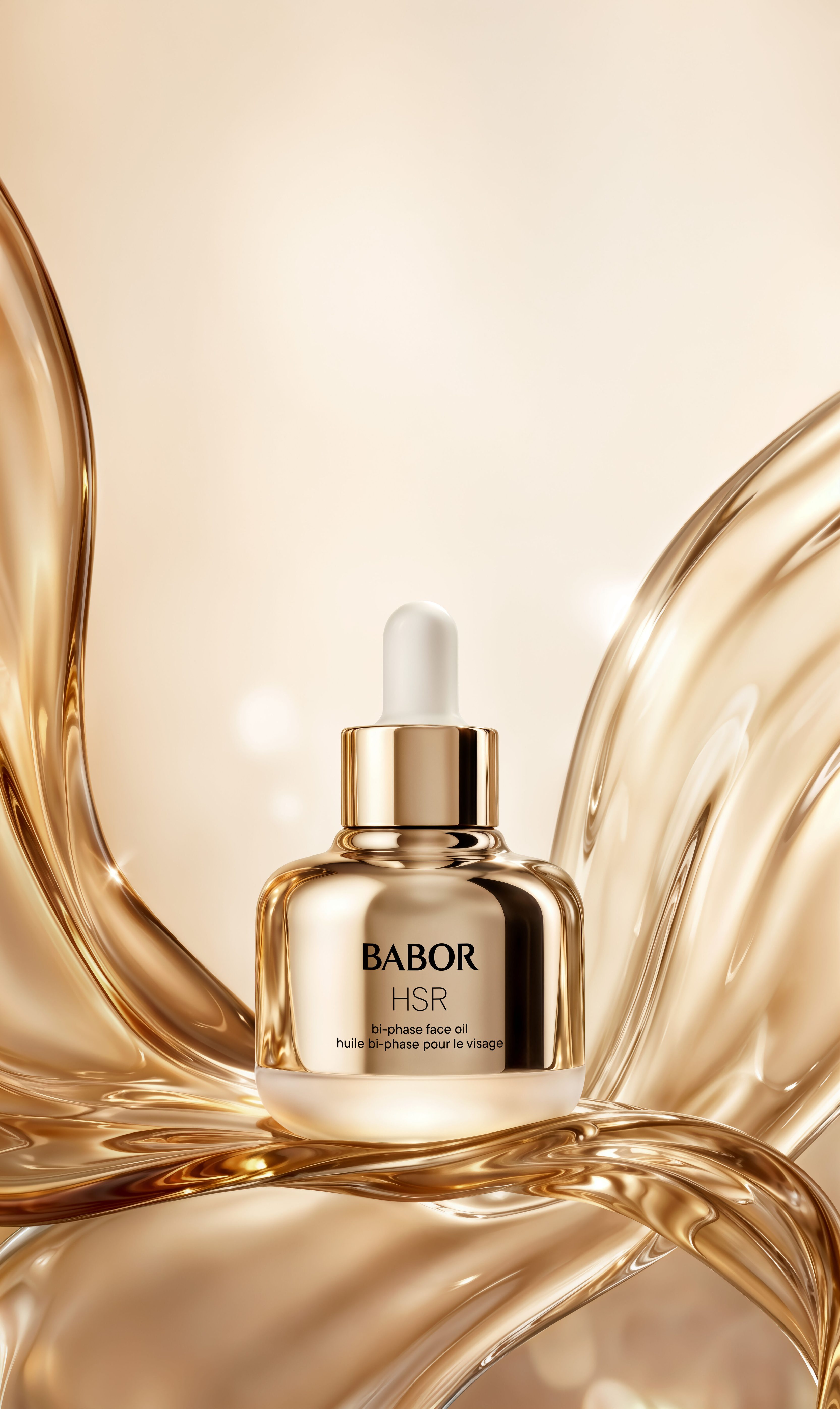

BABOR supports the HSR launch with efficacy data of its own, including a 28-day clinical study that the company says showed improvements in wrinkle depth, firmness and elasticity with twice-daily use. Those are BABOR’s claims and should be read as such, but they also illustrate the balance the category now tries to achieve between measurable performance and the emotional pleasure of using a product.
That balance becomes even more visible in the Fine Fragrance collection, because fragrance is not the most obvious extension for a professional skincare brand and it is certainly not an uncrowded one. Heritage houses, fashion brands, niche perfumers and new independent labels are all competing for attention, which means that entering the category only makes sense if the brand has a reason to be there.
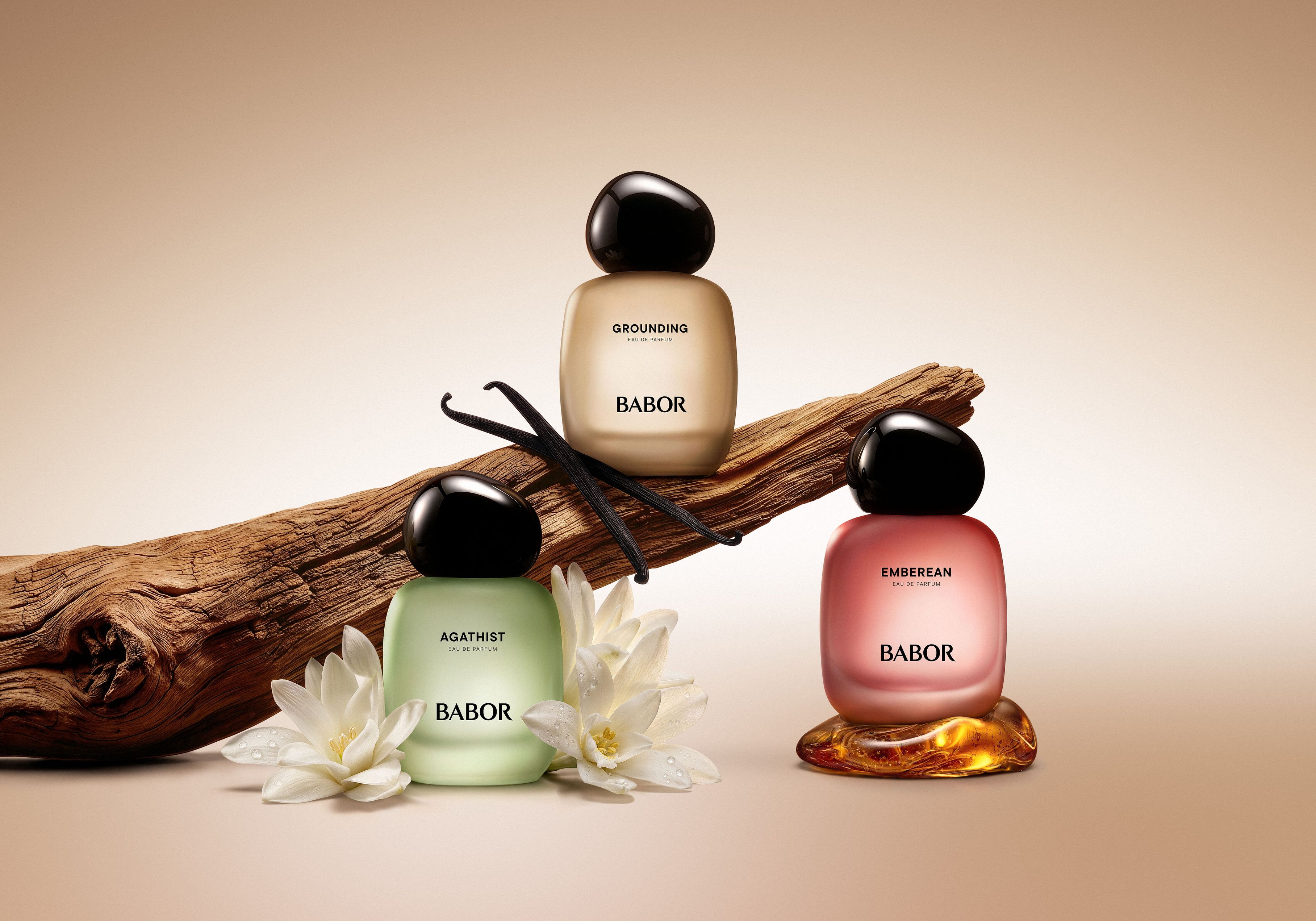
BABOR’s answer is to connect fragrance back to the broader territory of wellbeing. GROUNDING, AGATHIST and EMBEREAN are each built around a different emotional intention, with the collection described by the company as being inspired by neuroscience and by the relationship between scent, mood and personal experience.
I would be careful with that wording because “neuroscience-inspired” is one of those phrases that can very quickly sound more scientifically conclusive than it really is. The more interesting point is not whether a fragrance can medically redesign an emotional state, but that consumers increasingly expect beauty products to participate in mood, ritual and identity rather than simply changing appearance or adding scent.
The bottle design makes that ambition visible. BABOR describes the translucent glass and wave-like caps as being inspired by neural frequencies, while the fragrances themselves move through familiar olfactory territories in different ways. GROUNDING is positioned around calm and balance, AGATHIST around brightness and optimism, and EMBEREAN around warmth, confidence and presence.
The obvious question is whether the market needs another face oil and another three fragrances, and I think the industry should be comfortable hearing it. A mature category should force brands to justify what they add rather than assuming that the launch calendar is reason enough.
Innovation, at least in this context, is not the production of more. It is the ability to understand where a brand has credibility, how consumer expectations are shifting and whether a new object genuinely extends the world people already associate with the company.
That is what I found most interesting about the lunch. The HSR oil remains close to BABOR’s existing centre, while the fragrances move further away from the traditional core without pretending that the company has suddenly become a classical perfume house. Both launches test how far an established identity can travel without becoming unrecognisable.
For Nicole Süss, that will probably be one of the more interesting parts of the role across Germany, Austria and Switzerland. The opportunity is not to make a 75-year-old brand appear younger for the sake of appearing contemporary. It is to decide which parts of its history still create value and then allow that history enough flexibility to evolve.
In a market that already has almost everything, that may be a more meaningful definition of innovation than simply creating something new.

credits
Words and personal perspective
Taskin “Tash” Yüksel
Disclosure
Taskin attended the BABOR press lunch as an invited media guest. This article was not commissioned for publication by BABOR unless otherwise agreed in writing.
Publication
Exclusive to tash.at